
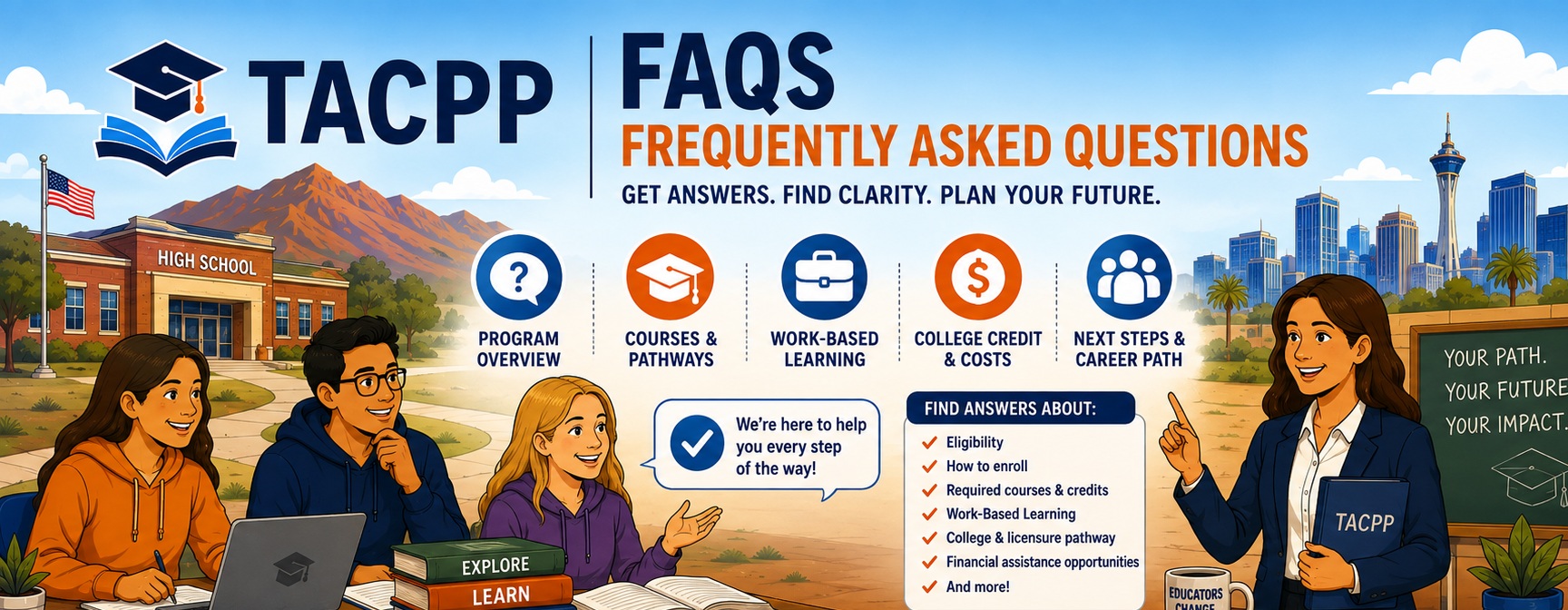
The Nevada Teacher Academy College Pathway Program (TACPP) is designed to help Nevada high school students explore teaching as a career and begin preparing for college and educator licensure while still in high school. The program creates a pathway from high school → college → educator preparation → Nevada teaching licensure → career.
TACPP was established through Assembly Bill 462 (2025) as part of Nevada’s effort to develop a strong pipeline of future educators.
TACPP is designed for high school students who are interested in exploring teaching and other careers in education. Students do not need to have their entire career planned before participating. TACPP can help students determine whether education is the right career choice for them while developing skills that are valuable in college and the workplace.
Students should speak with their school counselor to determine the TACPP opportunities available at their school and how the program can fit into their academic plan.
Start by visiting your school counseling office and telling your counselor that you are interested in TACPP.
Your counselor can explain the pathways available at your school, review your graduation plan, and help you select the appropriate coursework.
A great way to start the conversation is simply:
“I’m interested in the Nevada Teacher Academy College Pathway Program. How can I participate in TACPP at our school?”
Students can complete the high school portion of TACPP through one of two pathways.
Pathway 1 – Teaching and Training: Students complete Teaching and Training I and II and the required Work-Based Learning experience.
Pathway 2 – Education Dual Credit: Students complete 12 education-related dual credits and the required Work-Based Learning experience.
A school counselor can help students determine which pathway best fits their interests, schedule, and college plans.
Yes. One of the major advantages of TACPP is the opportunity for students to begin completing college-level education coursework while still in high school.
Students following the dual-credit pathway can complete qualifying education dual-credit courses. Beginning college coursework early can help students prepare for the transition to higher education and may reduce the amount of coursework they need to complete later.
Yes. Work-Based Learning is an important part of TACPP. Students complete a minimum of 15 hours of Work-Based Learning connected to the program.
These experiences give students an opportunity to learn about education outside of a traditional classroom course and may include activities such as classroom observation, mentoring, tutoring, or other approved education-related experiences.
The goal is to give students an opportunity to experience education firsthand before making a long-term career decision.
No. Participating in TACPP does not obligate a student to become a teacher.
TACPP gives students an opportunity to explore education before committing to a college major or career. Along the way, students can develop transferable skills such as communication, leadership, collaboration, organization, problem-solving, and professionalism.
Even if a student ultimately chooses another profession, the experience and skills developed through TACPP can still be valuable.
Students who decide to continue toward a teaching career can transition into higher education and work toward completing an educator preparation program and bachelor’s degree.
The long-term TACPP pathway is designed to connect the stages of becoming an educator:
High School → College → Bachelor’s Degree/Educator Preparation → Student Teaching → Nevada Teaching License → Teaching Career
Students should work with their high school counselor and prospective college or university to understand admission, transfer, degree, and licensure requirements.
TACPP may help students reduce college costs in several ways. For example, students may have opportunities to earn college credit while still in high school, potentially reducing future college coursework.
As students continue toward becoming Nevada educators, they may also qualify for state or institutional financial assistance, scholarships, tuition reimbursement, or educator workforce programs, including opportunities associated with Nevada’s efforts to grow its educator workforce.
Financial assistance programs have specific eligibility requirements and available funding can change, so students and families should verify current requirements before making financial decisions.
TACPP gives students something especially valuable: the opportunity to start exploring their future before graduating from high school.
Students can explore teaching, gain real-world experience, develop professional skills, earn college credit through qualifying coursework, and begin building a clear pathway toward college and a Nevada teaching career.
For families, TACPP can provide greater direction when planning for life after high school and help students make more informed decisions about college and careers.
Explore your future. Get a head start on college. Build a career. Make a difference in Nevada.
